This Week's Personal AI News:
The Arrival of FLUX 3, and From ComfyUI Into the Game Engine
(Jul 23-30)今週の私的なAIニュース:
FLUX 3の登場とComfyUIからゲームエンジンへ
(07-23〜07-30)
This week starts with four items from the paper-explainer channels (AI Era Compass, Two Minute Papers).
All of them are about efficiency — how much capability you can get out of the same compute — which is far from an academic question if you run things on your own GPU.
From there we move to the week's biggest news, Black Forest Labs' FLUX 3, then a workflow for piping ComfyUI output straight into a game engine, and finally what to look at when choosing a generation platform.
今週は、まず論文解説チャンネル(AI時代の羅針盤、Two Minute Papers)から4本を取り上げます。
いずれも「同じ計算量でどこまで賢くできるか」という効率の話で、手元のGPUで動かす環境にとっては他人事ではありません。
そのうえで、Black Forest LabsのFLUX 3という今週最大のニュースと、ComfyUIの出力をそのままゲームエンジンへ流し込むワークフロー、そして生成プラットフォームを選ぶときに何を見るべきかという話へと進みます。
Breaking Down Research (1): Looping Only the Middle Layers 研究を噛み砕く(1)真ん中の層だけを回す
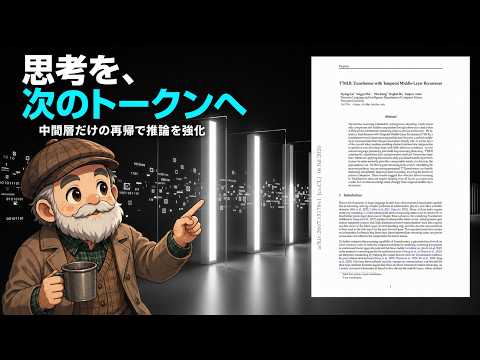
AI Era Compass covers T²MLR (Transformer with Temporal Middle-Layer Recurrence, 2607.15178).
It brings recurrence into the Transformer by routing intermediate representations from the deeper layers of the previous token back into the earlier layers of the current token through a gated pathway.
This creates room for a second pass of "thinking" along the depth axis while keeping token-level supervision dense.
The interesting finding: looping only a middle-layer block — as little as 20% of all layers — often outperforms looping the full stack.
Against compute-matched Transformer baselines, it reportedly wins consistently across both pretraining and multi-hop reasoning finetuning.
The implication is that strengthening latent reasoning doesn't require rebuilding the whole model.
AI時代の羅針盤が、T²MLR(Transformer with Temporal Middle-Layer Recurrence、2607.15178)を取り上げています。
トランスフォーマーに再帰の性質を持ち込む研究で、直前のトークンを処理したときの深い層の中間表現を、現在のトークンの浅い層へゲート付きの経路で戻す、という構造をとります。
深さ方向にもう一度考え直す余地を作りながら、トークン単位の教師信号は密なまま保てるのが利点です。
面白いのは、全層をループさせるより中間層のブロックだけ——全体の20%程度——をループさせたほうが性能が上回る場合が多い、と報告されている点です。
同じ推論コストのトランスフォーマーと比べて、事前学習でも多段推論のファインチューニングでも一貫して上回ったとされています。
潜在的な推論を強化するのに、モデル全体を作り直す必要はない、という示唆になります。
Breaking Down Research (2): Two From Kimi — Linear Attention and 2.8 Trillion Parameters 研究を噛み砕く(2)Kimiの二本立て — 線形アテンションと2.8兆パラメータ
Two Moonshot AI–related items landed this week.
First, Kimi Linear (2510.26692), covered by AI Era Compass.
Its core, Kimi Delta Attention (KDA), extends Gated DeltaNet with finer-grained gating to make better use of finite-state memory, and is interleaved with standard full-attention layers at a 3:1 ratio.
The design cuts KV-cache usage by up to 75% during long-sequence generation while preserving global information flow through the full-attention layers.
The released model has 48B total parameters with 3B activated, and reports roughly a 4x speedup on RULER at 128k context.
Second, Two Minute Papers covers Kimi K3 — 2.8 trillion parameters with a one-million-token context window, among the largest open-weight models ever published.
Reports place it below Claude Fable 5 and GPT-5.6 Sol overall, while beating both companies' previous-generation models on coding and agent evaluations.
The video's claim that it "broke the economics of AI" seems to point at the fact that something this large arrives weights-included at all.
From a local-execution standpoint, 2.8 trillion parameters is not going onto a personal GPU — but efficiency work like Kimi Linear coming out of the same organization may reach our hardware sooner.
Moonshot AI関連が今週は2本入ってきました。
ひとつはAI時代の羅針盤が扱ったKimi Linear(2510.26692)です。
中核となるKimi Delta Attention(KDA)は、Gated DeltaNetをより細かいゲート機構へ拡張し、有限状態の記憶を効率よく使えるようにしたもので、これを通常のフルアテンション層と3対1の比率で交互に配置します。
長い系列の生成でKVキャッシュを最大75%削減しながら、フルアテンション層で大域的な情報の流れを保つ設計です。
公開モデルは総パラメータ48B・活性化3Bで、128kコンテキストのRULERで約4倍の高速化が報告されています。
もうひとつはTwo Minute Papersが取り上げたKimi K3で、こちらは2.8兆パラメータ・コンテキスト100万トークンという、公開ウェイトとしては過去最大級のモデルです。
総合順位ではClaude Fable 5やGPT-5.6 Solの下につけつつ、前世代の商用モデルはコーディングやエージェント評価で上回ったと報じられています。
動画タイトルの「AIの経済性を壊した」は、この規模のものが重みごと降ってくること自体を指していると読めます。
ローカル実行の観点では、2.8兆パラメータは個人のGPUに載る話ではありませんが、Kimi Linearのような効率化研究が同じ組織から出ていることのほうが、むしろ手元への波及は早いかもしれません。


Breaking Down Research (3): Discovering the Way One Dreams 研究を噛み砕く(3)夢を見るように発見する
The third item is Discovery by Dreaming: Cross-Domain Recombination in Artificial Memory (2607.16256), also covered by AI Era Compass.
David Eagleman is among the authors, and it's a 38-page paper spanning machine learning, information retrieval, and neural/evolutionary computation.
What the title suggests is a framing that reproduces, over artificial memory, the phenomenon in which memories from different domains connect during sleep to produce new ideas — and then uses that as a mechanism for discovery.
As of this writing, however, neither the paper itself nor the video has been reviewed, so specifics on method and results are withheld and will be added after viewing.
The underlying idea — recombining existing knowledge across domains — may have something in common with the work of designing new imagery while carrying a large body of reference material.
3本目は、AI時代の羅針盤が扱ったDiscovery by Dreaming: Cross-Domain Recombination in Artificial Memory(2607.16256)です。
著者にDavid Eaglemanが名を連ねており、機械学習だけでなく情報検索や神経・進化計算の領域にもまたがる38ページの論文です。
題名から読み取れるのは、人が眠っているあいだに異なる領域の記憶が結びついて発想が生まれる、という現象を人工的な記憶の上で再現し、それを発見の手段として使う、という筋立てです。
ただし本稿の執筆時点では論文本文と動画本編の内容を確認できておらず、具体的な手法や成果の記述は控えます。
視聴後に追補します。
分野を横断して既存の知識を組み替える、という発想自体は、参考資料を大量に抱えたまま新しい絵づくりを考える背景制作の作業と、どこかで重なる部分があるかもしれません。

FLUX 3 Released — Images, Video, Audio, and Robot Action in One Model FLUX 3が公開 — 画像・動画・音声・ロボット動作をひとつのモデルで
The week's biggest news is FLUX 3, released by Black Forest Labs on July 23.
It's a multimodal flow model jointly trained on images, video, audio, and action prediction within a single architecture — and the company's first public video generation model.
It produces clips of up to 20 seconds with synchronized audio, supporting text-to-video, image-to-video, video-to-video from a reference clip, keyframe-to-video for controlled transitions, and a continuation mode that extends input video and audio.
In comparison testing it was reportedly preferred over Luma Ray 3.2 in 93% of cases and over Runway Gen-4.5 in 77%.
A robotics model, FLUX-mimic, derives from the same foundation and is said to be under trial at Audi.
For now, FLUX 3 Video and FLUX 3 Action are in early access, with FLUX 3 Image and open-weight versions to follow.
Given Black Forest Labs' track record of publishing weights, the practical question for production work is when that open-weight release lands — because the moment it enters the ComfyUI ecosystem, it becomes a tool you can actually use locally.
今週最大のニュースは、Black Forest Labsが7月23日に公開したFLUX 3です。
画像・動画・音声・行動予測を単一のアーキテクチャで同時に学習した、いわゆるマルチモーダルなフローモデルで、同社としては初の公開動画生成モデルにあたります。
最長20秒のクリップを音声同期つきで生成でき、テキストから動画、画像から動画、参照クリップからの動画変換、キーフレーム間の遷移制御、入力された映像と音声の続きを生成する継続モードが用意されています。
比較評価ではLuma Ray 3.2に対して93%、Runway Gen-4.5に対して77%の割合で好まれたと報告されています。
さらにFLUX-mimicというロボティクス向けモデルも同じ土台から派生しており、Audiが試験導入しているとされています。
現時点でFLUX 3 VideoとFLUX 3 Actionは早期アクセス、FLUX 3 Imageとオープンウェイト版は後追いで公開予定という段階です。
Black Forest Labsは従来から重みを公開してきた経緯があるので、背景制作の現場としてはこのオープンウェイト版がいつ来るかが実質的な焦点になります。
ComfyUIのエコシステムに載った瞬間から、手元で使える道具に変わるからです。


The Video Generation Race Moves to 4K, 60fps, 30 Seconds — MiniMax's Hailuo 3.0 動画生成の競争は4K・60fps・30秒へ — MiniMaxのHailuo 3.0
Theoretically Media introduces MiniMax's new video generation model as a "Seedance killer, with a twist."
According to various write-ups, Hailuo 3.0 moves from the previous generation's 1080p/30fps/10s up to native 4K, 60fps, and clips as long as 30 seconds, with synchronized audio generation for the first time.
It also carries a full set of control features — Director Mode camera control, motion brush, character consistency — positioning it head-to-head with the recent Seedance 2.5, Kling 3.0, and Veo 3.1.
What the "twist" refers to, though, requires watching the video; and the specs above come mainly from vendor and aggregator pages rather than verified primary sources, so treat this section as pending review.
If you only track the numbers, last week's Seedance 2.5 (30 seconds, 4K, 50 reference inputs) and this week's Hailuo 3.0 show top-line specs converging fast.
What differentiates them now is less resolution or duration than how reference inputs are handled and how finely direction can be controlled.
Theoretically Mediaが、MiniMaxの新しい動画生成モデルを「Seedance キラー、ただしひとひねりある」と紹介しています。
各所の紹介によれば、Hailuo 3.0は前世代の1080p・30fps・10秒から、ネイティブ4K・60fps・最長30秒へと引き上げられ、音声の同期生成にも初めて対応したとされています。
カメラ制御のDirector Modeやモーションブラシ、キャラクターの一貫性維持といった制御系も一通り備えており、先日のSeedance 2.5やKling 3.0、Veo 3.1と正面からぶつかる位置づけです。
ただし「ひとひねり」が何を指すのかは動画本編を見ないと分かりませんし、上記の仕様はベンダー側および紹介サイトの情報が中心で、一次資料での裏取りは取れていません。
ここは要視聴・要確認として扱います。
数字だけを追うなら、先週のSeedance 2.5(30秒・4K・50参照入力)と今週のHailuo 3.0で、上限のスペックは急速に横並びになりつつあります。
差がつくのは解像度や尺よりも、参照入力の扱いや制御の粒度といった、演出を握れるかどうかの部分になってきています。

From ComfyUI Into Unreal Engine and Unity — Getting Generated Assets Into a Game Engine ComfyUIからUnreal EngineとUnityへ — 生成物をゲームエンジンに載せる
Of everything in this week's material, this one sits closest to actual background production work.
GeekatPlay (Vladimir Chopine), a 3D/VFX channel, has a video on taking output made in ComfyUI into Unreal Engine and Unity and turning it into game assets.
The title lists 3D models, terrains, skydomes, and materials — essentially the full set of components that make up an environment.
The channel has continued to work on things like node integrations for image-to-3D generation, and this looks like an extension of that.
The specific steps and node setup are unwatched and will be filled in later.
What matters here is that the conversation around generative AI is shifting from "it produced a nice image" to "how do you get it into the engine."
In the sense that the real battleground is connecting to existing DCC and engine pipelines rather than raw generation quality, this is the direction worth following.
今週の材料のなかで、背景制作の作業そのものに一番近いのがこれです。
3D/VFX系のGeekatPlay(Vladimir Chopine)が、ComfyUIで作った成果物をUnreal EngineとUnityへ持ち込み、ゲームアセットに仕立てるまでを扱う動画を出しています。
件名で挙げられているのは3Dモデル、地形、スカイドーム、マテリアルで、つまり背景を構成する要素がほぼ一通り並んでいます。
同chはこれまでも画像から3Dを生成するノードの連携などを継続的に手掛けており、その延長にあたる内容と見られます。
具体的な手順やノード構成は未視聴のため、視聴後に追補します。
ここで重要なのは、生成AIの話題が「きれいな画が出た」から「その先どうエンジンに載せるか」へ移りつつあることです。
生成の質そのものより、既存のDCCとエンジンのパイプラインにどう接続するかが実務の勝負どころになるという意味で、この方向の情報は継続して拾っていきます。

Choosing a Platform Is Part of the Job — The Higgsfield Terms Controversy プラットフォームを選ぶという仕事 — Higgsfieldの規約騒動
Theoretically Media covers the controversy surrounding the generation platform Higgsfield.
The company runs a browser-based service that aggregates multiple generative models, and is a fast-growing business reported to have reached $500 million in annualized revenue by June 2026.
After it revised its terms of service on July 23, however, a thread on X spread the claim that the new terms granted the company perpetual, transferable rights over user content and training data — and the company subsequently rewrote them.
Earlier in 2026 there were also reports of its official account being suspended, criticism over the content of promotional material, and complaints about how hard cancellation was.
All of this comes from third-party reporting and commentary rather than a first-hand reading of the terms on our part, so no definitive claims here.
The point worth taking away isn't one company's reputation: once you fold a generation service into production, reading the rights terms and tracking how they change becomes part of the job.
That is also one of the reasons for not letting go of a local environment like ComfyUI.
Theoretically Mediaが、生成プラットフォームHiggsfieldをめぐる一連の騒ぎを取り上げています。
同社は複数の生成モデルをまとめて使えるブラウザ型のサービスで、2026年6月には年換算収益5億ドルに達したと報じられる急成長企業ですが、7月23日に利用規約を改定して以降、ユーザーの投稿コンテンツと学習データに対して恒久的かつ譲渡可能な権利を自らに与えているのではないか、という指摘がX上で拡散し、同社はその後規約を書き直しています。
2026年初頭にも公式アカウントの凍結や、プロモーション素材の内容をめぐる批判、解約手続きの分かりにくさといった問題が報じられていました。
いずれも第三者による指摘や報道が中心で、当方で規約の原文を突き合わせたわけではないため、断定は避けます。
ここで拾っておきたいのは個別企業の評判ではなく、生成サービスを制作に組み込む以上、出力の権利関係と規約の変更履歴を見る作業が仕事の一部になっている、という一点です。
ローカル環境(ComfyUI)を手放さない理由のひとつも、まさにここにあります。

What This Means for Creators 制作者にとっての意味
Looking at the week as a whole, the center of gravity has shifted from "what can the model do" toward "where do you run it, and how does it connect to your pipeline."
The three research items are all about efficiency: looping only the middle layers (T²MLR) and cutting KV cache to a quarter (Kimi Linear) are the kind of work that eventually raises the practical ceiling of models running locally.
On the tooling side, FLUX 3 unified images, video, audio, and action while promising open weights, and Hailuo 3.0 reached 4K, 60fps, and 30 seconds.
And as the GeekatPlay video shows, the process of getting generated output into Unreal Engine or Unity is finally being discussed as a concrete procedure.
The Higgsfield episode, meanwhile, is a reminder that depending on the cloud means a single terms revision can move the ground under you.
Explore what the large cloud models can reach, but keep the foundation of production local — everything in this week's material reinforces that two-tier posture.
今週を通して見ると、話の重心が「モデルが何をできるか」から「それをどこで動かし、どう自分のパイプラインに繋ぐか」へ寄っているのが分かります。
研究側の3本はいずれも効率の話で、真ん中の層だけを回す(T²MLR)、KVキャッシュを4分の1に減らす(Kimi Linear)といった工夫は、いずれローカルで動くモデルの現実的な性能を押し上げます。
ツール側では、FLUX 3が画像・動画・音声・行動を一本化してオープンウェイト版を予告し、Hailuo 3.0が4K・60fps・30秒まで到達しました。
そしてGeekatPlayの動画が示すように、生成物をUnreal EngineやUnityへ流し込む工程は、いよいよ具体的な手順として語られはじめています。
一方でHiggsfieldの件は、クラウド側に依存すると規約ひとつで足元が変わるという現実を思い出させます。
クラウドの大型モデルで届く範囲を試しつつ、最終的な制作の足場はローカルに置いておく——今週の材料はどれも、その二段構えを補強する方向に働いています。
Further viewing その他の参照動画
- Claude Opus 5 is a freak 2026-07 ・参考