This Week's Personal AI News:
Into the Age of Watermarked Output
(Aug 9-16)今週の私的なAIニュース:
生成物に透かしが入る時代へ
(08-09〜08-16)
Two stories about the provenance of output arrived at once this week: research showing that reasoning traces can be stolen through an API, and the news that Claude has started embedding invisible watermarks in what it generates.
They point in opposite directions, but both concern information attached to AI output — which matters when you deliver work to clients.
The second half covers a simultaneous refresh of local video generation and a render engine that turns rough Blender scenes into finished frames.
今週は、出力の「出どころ」をめぐる話が2本同時に来ました。
ひとつは推論の痕跡がAPI越しに盗めてしまうという研究、もうひとつはClaudeの生成物に不可視の透かしが入りはじめたという話です。
方向は逆ですが、どちらもAIの出力に紐づく情報を扱う話で、制作物を納品する立場からは他人事ではありません。
後半はローカル動画生成の一斉更新と、Blenderのラフを最終画に変えるレンダーエンジンを見ていきます。
Breaking Down Research: Hidden "Thinking" Could Be Stolen Through the API 研究を噛み砕く — 隠された「思考」はAPI越しに盗めた
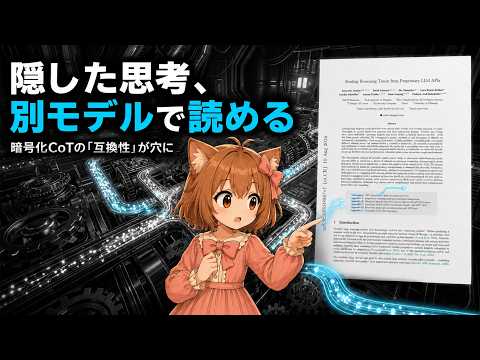
AI Era Compass covers "Stealing Reasoning Traces from Proprietary LLM APIs" (2608.09867, submitted August 10, 2026) from the ELLIS Institute Tübingen and Max Planck Institute.
Major LLM providers hide their models' step-by-step reasoning — the reasoning trace — to protect intellectual property and limit leakage.
But rather than keeping traces server-side, the implementation returns them to the client as blocks of encrypted text that the client passes back with each subsequent request.
The hole the researchers found: those encrypted blocks are interchangeable across sessions, users, and models within the same provider's ecosystem.
Inject one model's encrypted trace into a weaker, less-guarded model from the same provider, and it obligingly decodes and emits the trace verbatim in plaintext.
In practice they decoded 315,320 reasoning blocks and recovered 182 credentials; Anthropic, OpenAI, and Google were all reported to be using a single global key.
Scanning 6,708 publicly available agent traces further yielded 62 real API keys and 33 passwords.
Brought into a production context, this is a question of how far the intermediate state travels when you hand work to an agent.
If you build local generation setups or your own agents, keys and paths inevitably end up in prompts at some point.
Checking what is embedded in an execution log before publishing or sharing it has become genuinely necessary.
AI時代の羅針盤が、ELLIS Institute TübingenとMax Planck研究所らの論文「Stealing Reasoning Traces from Proprietary LLM APIs」(2608.09867、2026年8月10日投稿)を取り上げています。
主要なLLM提供元は、モデルの思考過程——いわゆる推論トレース——を知的財産の保護と情報漏れの抑制のために隠しています。
ところが実装は、トレースをサーバー側に保持するのではなく、暗号化されたテキストの塊としてクライアントへ返し、次のリクエストで送り返させる方式でした。
研究者が見つけた穴は、この暗号ブロックが同じ提供元のエコシステム内であればセッション・ユーザー・モデルをまたいで互換だという点です。
つまり、あるモデルの暗号化トレースを、同じ提供元のより弱く安全策の緩いモデルへ注入すると、そのモデルが素直に平文へ復号して出力してしまいます。
実測では315,320件の推論ブロックが復号され、182件の資格情報が回収されました。
Anthropic・OpenAI・Googleがいずれも単一のグローバル鍵を使っていたと報告されています。
さらに公開されているエージェントの実行ログ6,708件を走査したところ、実在のAPIキー62件とパスワード33件が拾えたとのことです。
制作の現場に引き寄せると、これは「エージェントに作業を任せたとき、その途中経過がどこまで外へ出るか」という話です。
ローカルの生成環境や自前のエージェントを組んでいると、鍵やパスをプロンプトへ入れる場面はどうしても出てきます。
実行ログを公開・共有する前に何が写り込んでいるか確認する習慣は、いよいよ必要になりました。
Claude Has Started Putting Invisible Watermarks on What It Generates Claudeの生成物に不可視の透かしが入りはじめた
Anthropic announced and began rolling out invisible watermarks in Claude's generated text.
Models released from August 2, 2026 onward embed a machine-readable signal into the text they produce.
It does not affect quality or readability, travels with the text through copy and paste, and is designed to survive a degree of editing.
Generated files carry digitally signed provenance metadata where the format supports it.
The coverage spans essentially every route by which people touch Claude: the API, Claude Code, Claude Cowork, and deployments via AWS, Google Cloud, and Microsoft Foundry.
The driver is Article 50 of the EU AI Act, enforceable from the same August 2 date, which requires generative AI providers to mark outputs in machine-readable form.
In other words, this is regulatory compliance more than corporate goodwill.
The limits are stated openly: detection shows that Claude had a hand in something, not that a Claude model produced the whole thing — which also means running a paragraph through proofreading or translation can leave a trace.
Online reaction has included pushback from people worried about being caught using AI at work or in class.
From a creator's standpoint, the practical framing is not threat but changed baseline: be able to explain which steps of a deliverable involved AI, and make how AI involvement is handled part of the agreement with a client.
Watermarking is the device that makes that conversation unavoidable.
Note that this section is based on press coverage and the provider's official help documentation rather than a video.
Anthropicが、Claudeの生成テキストに不可視の透かしを入れる方針を発表し、実施に入りました。
2026年8月2日以降に公開されたモデルは、生成した文章に機械可読な信号を埋め込みます。
品質や読みやすさには影響せず、コピー&ペーストしても付いてまわり、ある程度の編集にも耐える設計とされています。
生成ファイルについては、対応する形式であれば署名つきの来歴メタデータが付与されます。
適用範囲はAPI、Claude Code、Claude Cowork、そしてAWS・Google Cloud・Microsoft Foundry経由の利用まで、Claudeを触るほぼ全ての経路です。
背景にあるのはEU AI Actの第50条で、こちらも8月2日から執行可能になり、生成AIの提供者に対して出力を機械可読な形で標識することを求めています。
つまり企業の善意というより制度対応です。
限界も明示されています。
検出できるのは「Claudeが関与した」ことであって、全体をClaudeが書いたかどうかは分かりません。
逆に言えば、校正や翻訳を一段かけただけでも痕跡が残りうるということです。
ネット上では「仕事や課題でAIを使っていることが露見する」という反発も出ています。
制作者の立場では、これは脅威というより前提条件の変化として捉えるのが実際的だと思います。
納品物のどの工程にAIが入っているかを自分で説明できる状態にしておくこと、そしてクライアントとの取り決めに「AIの関与をどう扱うか」を含めておくこと。
透かしはその会話を避けられなくする装置です。
なお本節は動画ではなく、報道各社の記事と提供元の公式ヘルプを一次情報としてまとめています。
Turning a Rough Blender Scene Into a Final Frame — Mickmumpitz's AI Render Engine Blenderのラフを最終画に変える — MickmumpitzのAIレンダーエンジン
Mickmumpitz has an episode on a new AI render engine.
In June 2026 the channel released a free AI render engine for CG and facial animation built on ComfyUI plus Blender: rough out a scene in Blender, guide the style with reference images, and let AI assemble the final shot including lighting, effects, and lip sync driven from an audio file.
At the time it ran on LTX-2.3 and open models, entirely locally and for free.
This new episode appears to be a follow-up, and given that it lands right after the LTX-2.5 release covered below, it may well incorporate the newer model — but the video is unwatched, so that remains speculation and will be confirmed later.
What makes this approach important from a background-art standpoint is that it's the most fully realized example of using 3D as a specification for composition and space rather than as the deliverable.
If the look can be locked at the blockout stage, the allocation of time between modeling and texturing changes outright.
Conversely, the weight shifts onto the ability to design what a rough scene communicates — camera, silhouette, the placement of light and dark.
Mickmumpitzが新しいAIレンダーエンジンを扱う回を出しています。
同氏は2026年6月に、CGと表情アニメーション向けの無料AIレンダーエンジン(ComfyUI+Blender)を公開していました。
仕組みはBlenderでシーンをラフに組み、参照画像でスタイルを指示し、ライティングやエフェクト、音声からのリップシンクまで含めてAIに最終ショットを組ませる、というものです。
当時はLTX-2.3とオープンなモデル群で動き、すべてローカルで完結し無料である点が特徴でした。
今回の回はその続報にあたると見られ、後述するLTX-2.5の公開直後という時期を踏まえると新しいモデルへの対応が入っている可能性がありますが、本編は未視聴のため推測の域を出ません。
視聴後に追補します。
背景制作の立場でこの方式が重要なのは、3Dを「納品物」ではなく「構図と空間の指示書」として使う流れの、最も完成度の高い実例だからです。
ブロックアウトの段階でルックが確定できるなら、モデリングとテクスチャに費やす時間の配分そのものが変わります。
逆に、ラフが何を伝えられるかを設計する能力——カメラ、シルエット、明暗の配置——の重みが増していきます。

Local Video Generation Refreshed All at Once — LTX-2.5 and Wan 3.0 ローカル動画生成が一斉更新 — LTX-2.5とWan 3.0
Last time covered MiniMax H3's open-weight release; in the two weeks since, the situation moved further. LTX-2.5, from the company spun out of Lightricks, was released with open weights on August 11, 2026.
It's a 22B diffusion model that generates synchronized video and audio in a single model from text, image, or video input, with native multishot scenes, automatic duration, and 4K HDR output.
The speed stands out: a 10-second 720p image-to-video clip in 6.8 seconds on two NVIDIA GB200 chips, or 23.7 seconds through the LTX API.
Official ComfyUI workflow templates were available on day one and the weights are on Hugging Face.
The LTX-2.x Community License makes commercial use free for companies under $10M in annual revenue — terms that are directly usable in freelance practice.
The other is Alibaba's Wan 3.0, which entered public beta on August 6, 2026.
It reaches 30 seconds in a single pass — double the 15 seconds of the preceding Wan2.7 — and its headline Omni-Reference feature accepts documents, spreadsheets, slides, PDFs, and web pages as reference input alongside text, image, audio, and video (up to 100MB or 50 pages).
The direction is: throw your reference documents in as they are.
AI Search covers the H3-adjacent follow-up as "the best local AI video generator just got better," and on the Japanese side AI Illust Lab explains what Wan 3.0 can do.
Neither has been watched.
To summarize: within a month, open weights plus audio plus long duration plus speed have arrived from several different lineages at once.
The basis for choosing is shifting away from raw performance and toward licensing and whether it fits on your own GPU.
前回はMiniMax H3のオープンウェイト公開を取り上げましたが、その2週間で状況がさらに動きました。
Lightricksからスピンアウトしたシリコンが、2026年8月11日にLTX-2.5をオープンウェイトで公開しています。
22Bの拡散モデルで、テキスト・画像・動画の入力から映像と音声を単一モデルで同期生成し、ネイティブのマルチショット構成、自動での尺決定、4K HDR出力に対応します。
速度が目を引くところで、10秒・720pの画像→動画をNVIDIA GB200 2基で6.8秒、LTX API経由でも23.7秒と報告されています。
ComfyUIの公式ワークフローテンプレートが初日から用意され、重みはHugging Faceで配布されています。
ライセンスはLTX-2.xコミュニティライセンスで、年商1000万ドル未満の企業は商用利用が無償です。
フリーランスの実務でそのまま使える条件になっている点は見逃せません。
もう一方はAlibabaのWan 3.0で、2026年8月6日にパブリックベータへ入りました。
1回の生成で30秒——前世代Wan2.7の15秒の倍——に届き、目玉のOmni-Referenceはテキスト・画像・音声・動画に加えて文書・表計算・スライド・PDF・Webページまで参照入力として受け付けます(100MBまたは50ページまで)。
設定資料をそのまま投げ込める、という方向です。
AI Searchが「最良のローカル動画生成がさらに良くなった」としてH3周辺の続報を、日本語では「AIイラストLab.」がWan 3.0の実力を解説しています。
どちらも本編は未視聴です。
整理すると、オープンウェイトで音声つき・長尺・高速という条件が、この1か月で複数の系統から出揃いました。
選ぶ基準は性能よりも、ライセンスと自分のGPUに載るかどうかへ移りつつあります。



One Direction Bundles, the Other Strips Down 束ねる方向と、削ぎ落とす方向
GeekatPlay put out two contrasting pieces this week: one introducing a free creative studio that bundles 2D, 3D, ComfyUI, and agents into a single application, the other about a generative model under 512 KB.
The first moves toward consolidating into one environment the steps you used to shuttle between separate windows — an attempt to take the "graph as hub" role ComfyUI has played and deliver it as a more finished application.
The second runs the opposite experiment: how small can a generative model get?
512 KB is less than a single texture, closer to an icon; if meaningful generation is possible at that size, models change character from something you host on a server to something you ship inside an asset.
Neither video has been watched, so judgment on actual performance and usability is reserved.
Still, the fact that the bundling direction and the stripping-down direction came from the same channel in the same week says something about where this field currently sits.
An integrated studio lowers the cost of learning; a tiny model changes the assumptions about distribution.
For a working artist, the first is a "do I switch" decision and the second is something to file away as the premise a few years out.
今週のGeekatPlayは対照的な2本を出しています。
ひとつは2D・3D・ComfyUI・エージェントをひとつのアプリケーションに束ねる無料のクリエイティブスタジオの紹介、もうひとつは512KBを切るサイズの生成モデルの話です。
前者は、これまで別々のウィンドウを行き来していた工程をひとつの環境へ集約する方向で、ComfyUIが担ってきた「グラフというハブ」の役割を、より完成されたアプリケーションの形でやろうという流れに見えます。
後者は逆に、生成モデルをどこまで小さくできるかという実験です。
512KBというのはテクスチャ1枚どころかアイコン程度の容量で、そのサイズで意味のある生成ができるなら、モデルは「サーバーに置くもの」から「アセットに同梱するもの」へ性格を変えます。
どちらも本編は未視聴のため、具体的な性能や使い勝手の評価は保留します。
ただ、束ねる方向と削ぎ落とす方向が同じ週に同じチャンネルから出てくること自体が、この分野の現在地をよく表しているとは思います。
統合されたスタジオは学習コストを下げ、極小のモデルは配布の前提を変えます。
制作者としては、前者は「乗り換えるか」の判断、後者は「数年後の前提」として頭に置いておく話です。


What This Means for Creators 制作者にとっての意味
This week's material split cleanly into two layers: capability and regulation.
On the capability side, LTX-2.5 and Wan 3.0 moved local video generation up a notch, and implementations like Mickmumpitz's render engine continue to advance the use of 3D as a specification.
On the regulatory side, watermarks and provenance metadata are becoming standard equipment, while the reasoning-trace research showed that exchanges with AI are less closed than assumed.
The two layers are connected.
Until now the reasons for choosing a fully local setup were cost and speed; from here, knowing what is left where becomes another.
At the same time, watermarking is now an unavoidable premise, so the practical move is toward being able to explain rather than to conceal.
Which steps involved AI, and which were your own hands — putting that into words is, in the end, also how you define the outline of your own work.
Next week continues on the same criteria: can it be brought into your own setup, and can you explain it.
今週の材料は、性能の話と制度の話がはっきり二層に分かれていました。
性能側では、LTX-2.5とWan 3.0でローカル動画生成の条件が一段更新され、Mickmumpitzのレンダーエンジンのように3Dを指示書として使う実装も進んでいます。
制度側では、透かしと来歴メタデータが標準装備になりつつあり、推論トレースの窃取という研究は「AIとのやり取りは思ったほど閉じていない」ことを示しました。
この二層は無関係ではありません。
ローカルで完結する環境を選ぶ理由が、これまでは費用と速度だったのに対し、今後は「どこに何が残るか」を自分で把握できるという点が加わります。
同時に、透かしが入るのは避けられない前提になったので、隠す方向ではなく説明できる方向へ寄せるのが現実的です。
どの工程にAIが入り、どこは自分の手なのか。
それを言語化しておくことは、結局のところ自分の仕事の輪郭を自分で決めることでもあります。
来週も同じ基準——手元に落とし込めるか、そして説明できるか——で追っていきます。
Further viewing その他の参照動画
- Thought-Level Beam Search for Reasoning(2608.08020)【論文解説シリーズ】 2026-08 ・要視聴
- OpenAI's AI Agents Just Crossed A Line 2026-08 ・要視聴
- Claude AI Failed 650 Times…Then Beat The Human Record 2026-08 ・要視聴